
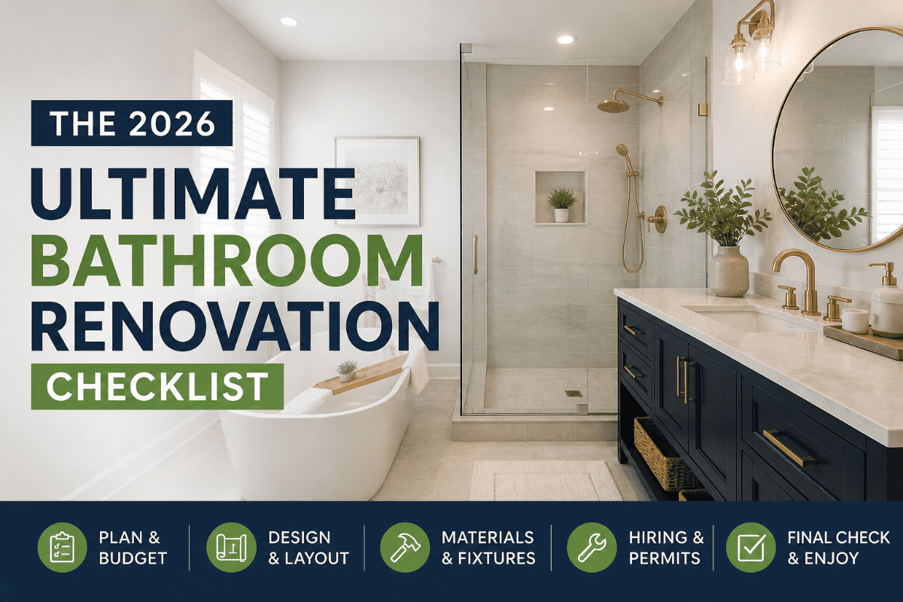
A strong 2026 bathroom renovation checklist has ten items. Set your goals and budget first. Assess the room you have. Choose a layout. Settle the plumbing. Pick tile and flooring. Choose a shower or tub. Select a vanity and countertop. Finalize fixtures and storage. Plan construction. End with a final walkthrough. Your exact list depends on room size, existing conditions, scope, materials, and layout changes. Work in this order, and you avoid costly changes after demolition starts. Long Island homeowners can bring this list to a first consultation and ask sharper questions.
What Is Bathroom Renovation?
Bathroom renovation is any project that updates or redesigns your bathroom. It ranges from a few targeted upgrades to a complete rebuild. Tile, flooring, plumbing, fixtures, the shower, the tub, the vanity, the countertop, and the layout can all be part of it.
How Does Bathroom Renovation Work?
Every good project follows the same logic. We review the existing bathroom, define your goals, and measure the space. Then we plan the layout and select materials. Plumbing, fixtures, and shower or tub options come next. Construction and installation follow. A final walkthrough closes the job. Early decisions drive every later step, so we never skip the planning.
Areas Commonly Included in Bathroom Renovation
- Bathroom flooring: It must handle water, foot traffic, and daily cleaning.
- Custom tile installation: Tile sets the look and protects wet areas.
- Shower areas: Size, entry, and storage niches shape how the room feels.
- Bathtub areas: A tub can be replaced, resized, or removed for more space.
- Vanities and countertops: These control storage and daily workflow.
- Plumbing fixtures: Faucets, valves, and drains affect comfort and performance.
- Bathroom layout: The floor plan decides how you move through the room.
- Project-specific elements: Lighting, ventilation, and accessories depend on your goals.
What Are the Steps to Renovate a Bathroom?
A bathroom renovation moves from planning to design, then to construction and review. Knowing the sequence helps you separate design decisions, such as style and materials, from construction decisions, such as plumbing work and scheduling
| Step | What Happens |
|---|---|
| Consultation and Planning | Goals, style preferences, budget, existing conditions, and project requirements are reviewed. |
| Design and Layout | The bathroom layout and design are developed around the available space and homeowner needs. |
| Material Selection | Tile, flooring, fixtures, shower or tub features, vanity, and countertop materials are selected. |
| Design Visualization | Detailed designs or 3D renderings may help homeowners understand the proposed result before construction. |
| Construction and Preparation | Existing elements are removed or prepared, and required construction work begins. |
Not every project follows the same order. Scope and existing conditions can change the sequence.
The Process Behind Bathroom Renovation
The process protects your budget and your schedule. We start with your goals, your style, and the condition of the current bathroom. Then we decide whether to keep the footprint or redesign it. This is where custom bathroom layouts begin to take shape.
Next, we match tile and flooring so they work together in looks and in wet-area performance. Plumbing and fixtures get planned at the same stage. We decide where the shower, tub, and vanity can go. We also choose vanities with storage in mind, since a pretty vanity that holds nothing becomes a daily annoyance.
Design visualization shows you the plan before we build. Then construction, installation, and a final walkthrough follow. We describe our process as consultation, design, construction, and walkthrough. Each stage needs the one before it.
Read More :- Walk-In Showers vs. Bathtubs: Which Is Better?
Benefits and Limitations of Bathroom Renovation
Benefits of Proper Bathroom Renovation
- Better function: A planned layout improves movement, fixture placement, and daily use.
- Updated surfaces: New tile and flooring refresh the room and can withstand moisture and wear.
- More storage: A well-chosen vanity keeps daily items within reach and off the counter.
- Custom vanity options: You can match size, style, and storage to your space.
- Coordinated materials: Tile, fixtures, and finishes work as one design.
- Personalized design: The finished room reflects how you actually use it.
Limitations of Bathroom Renovation
- Costs vary: Price depends on scope, materials, existing conditions, and construction needs.
- Layout changes add work: Moving fixtures can increase plumbing and construction requirements.
- Material availability matters: Delays in tile, vanities, or fixtures can shift the schedule.
- Hidden issues can appear: Plumbing or structural problems behind walls may require added work.
- Planning takes effort: Late decisions slow the project and raise stress.
How to Prepare for Bathroom Renovation
Before Renovation
- Define your goals: Know what you want to fix, such as storage, safety, or style.
- Set a budget and rank priorities: This tells you where to spend and where to save.
- Measure and review the space: Note what works and what frustrates you today.
- Decide on the layout: Keeping it costs less. Changing it can solve bigger problems.
- Collect material ideas: Gather tile, flooring, fixture, vanity, and countertop options.
- Meet a bathroom renovation contractor: Review scope and feasibility before you commit.
Renovation Tips
- Plan the layout first: Every later choice depends on it.
- Choose materials for function: Looks matter, but moisture and slip resistance matter more.
- Coordinate tile and flooring: They share sightlines and should feel connected.
- Plan plumbing early: Late changes cost more than early ones.
- Think storage before you buy a vanity: Count what you need to store.
- Use the final walkthrough: Check every detail before you call the job done.
Does Bathroom Renovation Take a Long Time?
We usually see a bathroom remodel take about two to four weeks. This is our own estimate, not a universal timeline. Material availability and unexpected plumbing or structural repairs can change it.
DIY Bathroom Renovation vs. Professional Installation: Which Is Right for You?
The right choice depends on your skills and your scope. A small update can suit an experienced DIYer. A larger project needs more coordination. Weigh these factors:
- Your experience
- Project scope
- Plumbing requirements
- Layout changes
- Tile installation
- Time available
- Project goals
DIY is not always unsafe or inferior. Professional help simply grows more valuable as the work gets more complex.
| Feature | DIY Bathroom Renovation | Professional Installation |
|---|---|---|
| Primary Goal | Homeowner completes selected improvements independently | Professionals complete renovation work |
| Approach | Homeowner manages planning and renovation tasks | Professionals coordinate work around project requirements |
| Best For | Appropriate for smaller projects for experienced homeowners | Larger or multi-part remodeling projects |
| Project Scope | Depends on homeowner skill and project complexity | Suitable for coordinated remodeling work |
| Plumbing Work | Homeowner must understand what work is appropriate | Professional team can manage plumbing upgrades and fixture installation |
| Tile Installation | Homeowner handles installation | Professional team handles custom tile and flooring |
| Layout Changes | Homeowner manages planning and construction | Professionals can manage larger layout changes |
| Long-Term Approach | Requires homeowner planning and coordination | Provides support from design through completion |
Depending on the scope of the work and local requirements, permits or inspections may be necessary. A qualified remodeling professional can help determine what applies to your project.
Is Bathroom Renovation Right for You?
Renovation makes sense when your bathroom no longer fits your life. A full bathroom renovation is often the smarter move when several parts of the room need attention at once. Fixing them together saves repeat disruption.
You May Benefit From Bathroom Renovation If…
- You want better functionality.
- You want new tile or flooring.
- You need a new vanity or countertop.
- You want upgraded plumbing fixtures.
- You want to redesign the layout.
Consider Professional Installation If…
- The project includes plumbing upgrades.
- You want custom tile or flooring installation.
- You need a new shower or tub.
- You want a full layout redesign.
- You want help from design through construction.
Each item above calls for coordinated trades. [INTERNAL LINK: bathroom remodeling]
Common Bathroom Renovation Myths and Facts
| Myth | Fact |
|---|---|
| Bathroom renovation only means replacing fixtures | Renovation can include tile, flooring, plumbing, shower or tub installation, vanities, countertops, and layout changes. |
| Every bathroom renovation follows the same process | The process depends on scope, existing conditions, materials, design, and construction needs. |
| A bathroom layout cannot be changed | Layout redesigns may be possible when the current arrangement does not meet your needs. |
| A vanity is only for appearance | A well-planned vanity supports both storage and function. |
| Bathroom renovation is only about design | Success also requires planning, construction, installation, plumbing review, and a final check. |
Ready to Renovate Your Bathroom?
A bathroom renovation consultation turns ideas into a plan. Creative Design Ceramic Tile & Bath has served Long Island homeowners since 1986 and describes its team as licensed and insured. Services include bathroom design and planning, custom tile and flooring installation, plumbing and fixture upgrades, shower and tub installation, vanity and countertop upgrades, and full layout redesigns.
Bring your goals, budget, layout ideas, preferred materials, and fixture questions. Ask about construction requirements too. The team can help you decide what fits your home.
Frequently Asked Questions
Q1: What should be included in a 2026 bathroom renovation checklist?
Include goals, budget, layout, plumbing, tile, flooring, shower or tub, vanity, fixtures, storage, construction planning, and a final walkthrough. Settle these in order so major decisions are made before construction begins.
Q2: How do I prepare for a bathroom renovation?
Define your goals and budget first. Then review existing conditions, decide on the layout, and gather material and fixture ideas. Book a consultation to confirm scope and feasibility before scheduling construction.
Q3: What does a bathroom remodeling service include?
Services vary, but a bathroom renovation service may cover design, layout planning, tile, flooring, plumbing, fixtures, shower or tub installation, vanity and countertop work, construction, and a final walkthrough. Ask for a written scope.
Q4: Can I change my existing bathroom layout?
Yes, often. Feasibility depends on the existing space, plumbing locations, construction requirements, and your goals. A professional can review the room and explain which bathroom renovation design services and layouts are practical.
Q5: What types of tile can be used in a bathroom remodel?
Common choices include ceramic, porcelain, natural stone, and glass accents. Choose by location, moisture exposure, maintenance, slip resistance, size, and texture. Shower floors and main floors have different needs.
Q6: Can bathroom plumbing and fixtures be upgraded during remodeling?
Yes, usually. Review the scope before construction, because hidden pipe conditions or moved fixtures can change the work. Early bathroom renovation planning services help you match fixtures to your layout.
Q7: How long does a bathroom renovation usually take?
We usually see about two to four weeks. Actual timing depends on scope, material availability, plumbing conditions, and unexpected structural repairs. Treat this as a company estimate, not a universal timeline.